Showing posts with label Landscaping. Show all posts

Saturday, December 3, 2011

Bougainvillea goes to Town

 Over the past three summers in Kansas I've planted these Texas purchased bougainvilleas in the garden. Two are five years old, one is red and the other orange flowered. Another was given to me by my mother last fall. When I lived in San Antonio they were some of my favorite container plants but were somewhat persnickety when it comes to producing blooms. I researched many different methods to produce blooms and discovered a few rules of thumbs for my particular growing zone in Kansas. They bloom more often when they are pot bound. Many landscape contractors will transplant the growing pot into the new pot and slit the growing pot down the sides to allow some root escape. They are heavy feeders , but  heavy nitrogen amounts will create more foliage than blooms (kinda like tomatoes). They seem to do very well in my compost enriched soil with no additional feeding. When moved from one growing condition to another they often take 3-4 weeks to recover and resume healthy growth. They must have full sun to bloom. They will do fine in partial shade but will not bloom as well if at all. And of course good drainage is important.
 The above photo is the orange flowering variety purchased at a Home Depot in Corpus Christi, Texas over five years ago in a #1 pot. Planted in the hell strip, it gets full sun surrounded by asphalt and concrete on two sides. These photos were taken November 13th before the big freeze. The tallest vines are 5-6' tall.
Here I am pruning the vines before transplanting and moving indoors. What a shame I suppose to cut those blooms.
Are you nuts, thinks my wife?
Many branch vines.
Time to root prune. Not much left there.
Pulled from soil in original pot from the spring planting, a 10-12" plastic one.
Surprised to see such small roots?
 Pruning roots before taking inside.
Looks like a bonsai doesn't it? This was three weeks ago and today the plant which is set in a west facing window is producing  a flush of new growth. I'll create a new post during planting time in the spring.  Which I wish was closer than it is. 
-Greg


Monday, October 3, 2011

Xeriscape Post San Antonio - Part Three

This is part three of the tour of the San Antonio Botanical Gardens Xeriscape Demonstration Gardens. Part one dealt with the Manicured Xeriscape Garden and a typical traditional American Garden: Part One.
Part two demonstrates my favorite example of xeriscape - The Hill Country Landscape Garden: Part Two.
Click on those links to read those previous posts.
After reading the comments on the first post, Pam Penick from Digging fame left me a link of a past visit to these gardens by her and other fellow Austin bloggers. I will leave a link back here. Watersaver Lane
It was cool to go back and look at these gardens when they were "young". They have matured since this 2007 post. Also she gave me the name of the series of gardens, Watersaver Lane. Thank you Pam!

The fourth garden is the cottage garden: photo above. As you can see there is a nice transition from the Hill Country motif to a cottage garden motif. The cedar rail fence delineates the two very well. Also the Datura blends with both gardens.
This is a true cottage garden. Seedlings come up  and grow and are left to mature. Woah, do they grow. This is garden is definelty full.

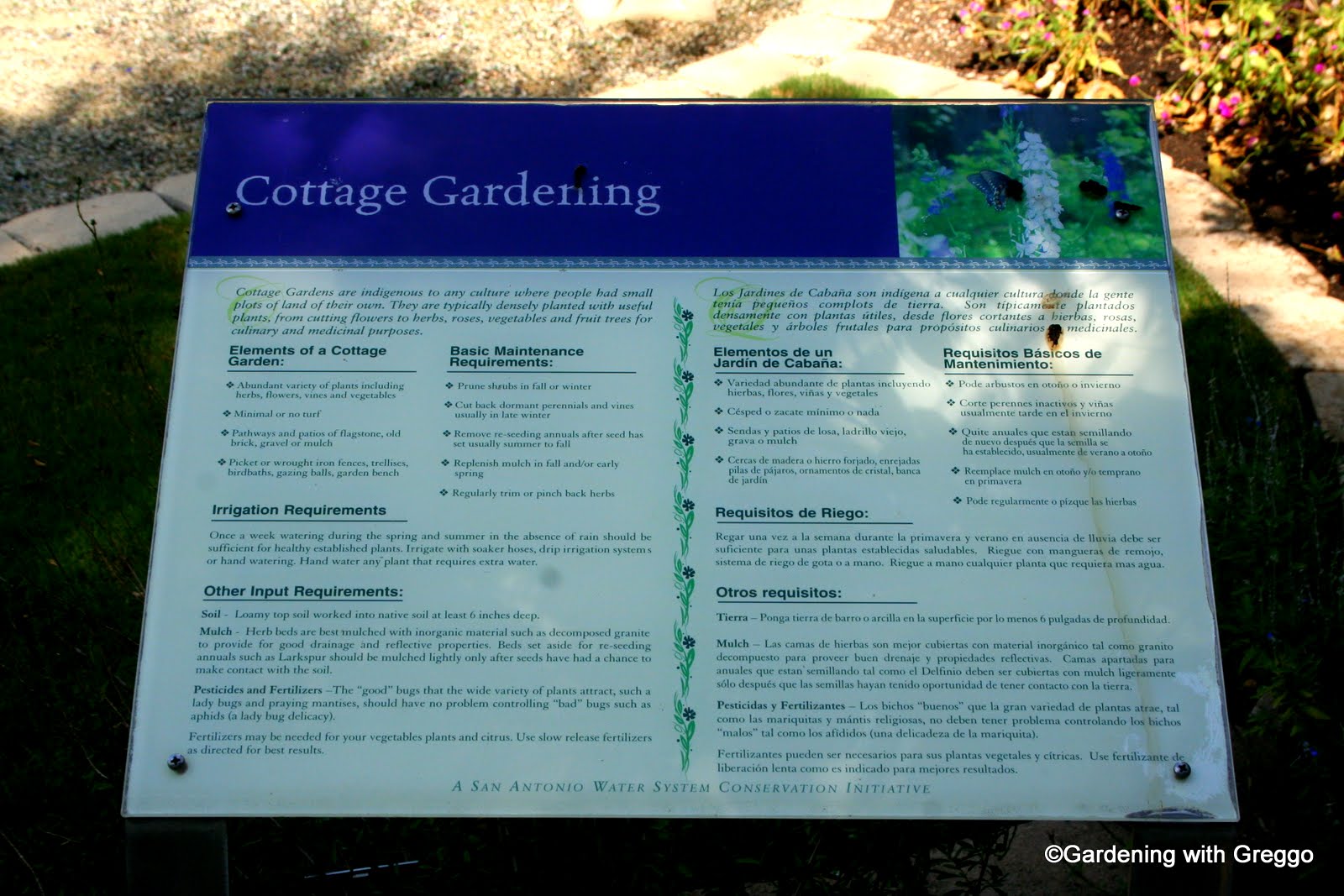
Click on above image to read design elements, water requirements and other input requirements.
The signage fence design consisted of uniquely formed depressed pickets.
 The pathway materials consisted of decomposed granite with recycled and tumbled (to remove sharp edges) glass. Austin bloggers are very familiar with this mulch. Edging material consists of preformed limestone looking concrete uniform brick.
Flowering Pear in background with perennial salvia and bedding annuals.
Typical cottage garden stalwarts positioned in water zones common to their own water requirements. Heirloom roses, mexican mint marigold, artemesia, salvia greggi, shrimp plant and daylilly with Indian Hawthorne hedge among others. And of course reseeding annuals plan a part. An arbor over the front of the "home" distinguishes this garden theme, covered with Confederate jasmine I believe. I can imagine how much color there would be here in the spring and fall. Accessories adorn the theme.
By using plants with the same irrigation requirements we could all conserve much needed water resources. The next post will conclude my visit to Watersaver Lane, click on this link along with Pam's link above to look at more information about these "fun" demonstration themed xeriscape gardens. As Les from A Tidewater Garden put it: Xeriscape is more than Yucca and a sea of gravel, it can present color, texture, variety, and good design. David from The Desert Edge comments often about good and bad xeriscape designed gardens, you may want to visit his New Mexico garden blog site to learn more.
Onward through the fog! lol.


Wednesday, September 28, 2011

Xeriscape Post-Again You Ask?

I'm sure some of you remember my posts this summer about the Xeriscape demonstration gardens in Colorado Springs. I went on and on about the "rules", points, suggestions, etc., etc. etc. Well for the past two months I've been trying to put together another xeriscape post from the San Antonio Botanical Gardens. The staff there has put together some unique demonstration gardens. They are well planned and installed exhibitions of "themed" gardens. I will start with the  Manicured Xeriscape Landscape Demonstration Garden.
On every garden there is signage explaining the details and management tips on having that type of garden. There is also signage giving the viewer the ability to call a number and listen to a recorded message explaining details of the garden. The signs were pretty dirty with droppings, as most of the staff was too busy hand watering due to the mega drought and probably not able to find much time to do housekeeping. Click on the images to enlarge.
The photo below is a wide angle view of the Manicured Xeriscape. Excuse me about this photo as it was a 108 and just a little bit sunny. The sign from the first photo is the same one on top of the small section of fence. Each garden has a sign with a uniquely designed section of fence below it. This one has a cattle panel section with a contemporary style.
Most of the turfgrass and plants are labeled. The turfgrass is zoysia, and yes that is jasmine ground cover. Many of you probably ask: how can that be xeriscape? Remember one principle is to put like plants together according to their water usage in the same zone. This example is a manicured garden for those who want to save a little more water (Zoysia lawn compared to a Saint Augustine lawn) and jasmine ground cover when once established can take some drought. Also you can allow Zoysia to go dormant as it is a warm season grass and it will recover when it rains. Rain? Well maybe. Once a week irrigation keeps Zoysia green and it can take partial shade. Also this garden has herbaceous perennials planted instead of annuals. Notice the architectural style of the small building. Each garden has their own unique building style.

 Decomposed granite is typical of the pathways leading to the different gardens. DG leads up to this building above with hardscape brick near the stoop. Wouldn't you call this manicured? I believe that is an existing live oak on the left. Shade is an important feature in this garden. Also you are viewing the sign and fence detail on the right which is an example of the next garden.

The traditional lawn. This garden is an example of the traditional American landscape. This is not a xeriscape garden.
I suppose this is not what to do. lol. Click to view the elements of the landscape and maintenance requirements in this region. Notice the high maintnance clipped Photinia foundation planting, Crepe Myrtle in the background, clipped box hedge, Saint Augustine turfgrass and annuals. It's actually a nice looking garden but uses more water to keep it green.
I suppose the only thing missing in this region is a Arizona Ash tree. In other parts of the country these plants would be interchanged with privet, large juniper, bluegrass or fescue turfgrass. The next four gardens will be posted in coming days. These will include The Texas Hill Country garden, the Cottage Garden, the Wildscape garden and the Spanish Courtyard Garden. Remember this tour was in late July this summer, so judge them on how well they look in this drought and what type of plants are being used and how much maintenance and water is being applied to "look" good.


Sunday, September 4, 2011

Snow in Kansas

Yes that's Right! Snow as in Snowbank. 
Boltonia asteroides 'Snowbank'
Isn't that a great combination. Boltonia asteroides 'snowbank', Miscanthus sinensis 'variegatus', Salvia guaranitica 'black and blue', and Rosa 'flower carpet red'.
This combination should really pop when the foreground asters begin to bloom. The hollyhocks on the left finally succumbed to the dreaded rust miester curse.
When I first read a description of snowbank, about their daisy flowers and late summer blooming period it peaked my interest. I was in the process of designing a new perennial bed. Snowbank's size and growing conditions met the requirements needed. So I ordered a kit garden from a mail order nursery as this was a way to add quantity and save money. And so the story begins.
Before: January 2010 New Perennial Bed - Mostly vinca minor and volunteer seedlings and of course loaded with nutgrass, the bad carex.
March 2010: Defining the Bed outline. Removing sod and moving it to raise grade in front of bed.(bottom of photo)
April 2010: Adding Flower Carpet Rose, underground drainage pipe with catch basin (below), and field stone border.
April 22 2010: Plants arrive one week after normal last frost. That's Boltonia bottom right.
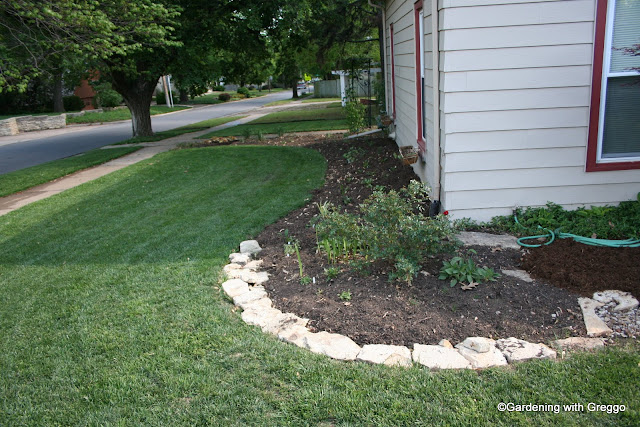
May 2010: Perennials Planted, more field stone edging added and stone drainage feature added over drain grate.
June 2010: Good growth and removal of nutgrass.
July 2010: Our 1st year in our cottage anniversary. Perennials begin to push. Removal of nutgrass, arghhh.
Boltonia behind, near the house and behind the rose.
April 2011: a new spring. Boltonia is sleeping. No nutgrass yet.
May 2011: Additions to Perennial Bed, an Alaskan of all things. Why not?
This post is about snow.
Late May 2011: Roses are in their glory. Boltonia peeking from the top.
Late May 2011: Son of a Biscuit! What's that yellow grass appearing?
June 1 2011: taking shape. Notice the nice temporary perennial rye grass?
Middle June 2011: Above and Below
July 2011: Above and Below. Boltonia foliage to right.
July 2011
August 2011
Late August 2010: Snowbank in its' starring role as a backup or I should say backdrop.
No need to get the snow shovel out. Even though it's 63 this morning after 50 days of 100. Awesome!