Showing posts with label Schizachyrium scoparium. Show all posts

Saturday, October 24, 2015

On the Farm

Cindy and I visited her parents last weekend which I enjoyed the fellowship as well as visiting parcels of their farm and pasture lands. The above image is from the "Whorton" place, an 80 (80 acres) of a section. This land was purchased by Cindy's dad, John, for his wife and Cindy's mother Lola Jean. It was a present for Lola for taking care of his mother over a year when she was sick with cancer.
Most parcels are described as 80's (80 acres), quarters (160 acres), half sections (320 acres) and full sections (640 acres) which are a mile square. This area is in far northwestern Oklahoma, with a annual average rainfall of 20-25" a year, with very sandy soils which have low water holding capacity. This visit the sandy soils were very dry, and most of the cultivated land is planted with cereal wheat which is in dire need of moisture.
I have hunted quail on this particular property for most of my adult life and always enjoy coming back and reminiscing.
Most of the land parcels are named after people whom previously owned the property or the leaser if the land is leased. Almost all of the quarters in the area have some kind of oil wells which have cattle guards so the oil maintenance workers (called pumpers) can check their wells. This image above serves as the entrance with a cattle guard which allows entrance without a gate but keeps cattle from leaving. Also the image above shows a old corral with a windmill and stock tank. The land is primarily tallgrass prairie plants planted during the Conservation Reserve Program 20-30 years ago when the federal government paid farmers to take marginal cultivated land out of production and plant into prairie grasses and legumes and to be be left still. Recently many farmers have took these properties out of the program and replanted them or began cutting the prairie for hay which my in-laws have done. This land contains mainly Big(Andropogon)and Little Bluestem (Schizachyrium) mainly on the high ground, Switchgrass (Paniucum) in the low areas which hold more moisture, and Sand Lovegrass (Erogrostis) which was planted across the road and has blown in and populated the old CRP plantings. The Love grass is not as beneficial for cattle as the Bluestems and Switchgrass. In the areas which are not planted in CRP the old short grass prairie plants are more prevalent such as Buffalograss, Gramma grasses, native Eragrostis and various forbs. Native Artemisias are prevelant along ditchbanks with wild plum thickets and annual Buckwheat prevalent this time of year.
Artemisia frigada-Fringed sagebrush with Ereigonum annum-Annual Buckwheat, Quercus marilandice-Blackjack Oak and Helianthus spp-sunflower. 
Annual Buckwheat bloom.
Sorry for the quality of the images as they are all taken. from a iPhone. I left my DSLR at home of all places.
You can see the red tint to the sandy soil, definitely common to many parts of Oklahoma. I'll be adding more images and story on my next blog post. Bye.


Thursday, July 25, 2013

Little Blue and Turkeyfoot

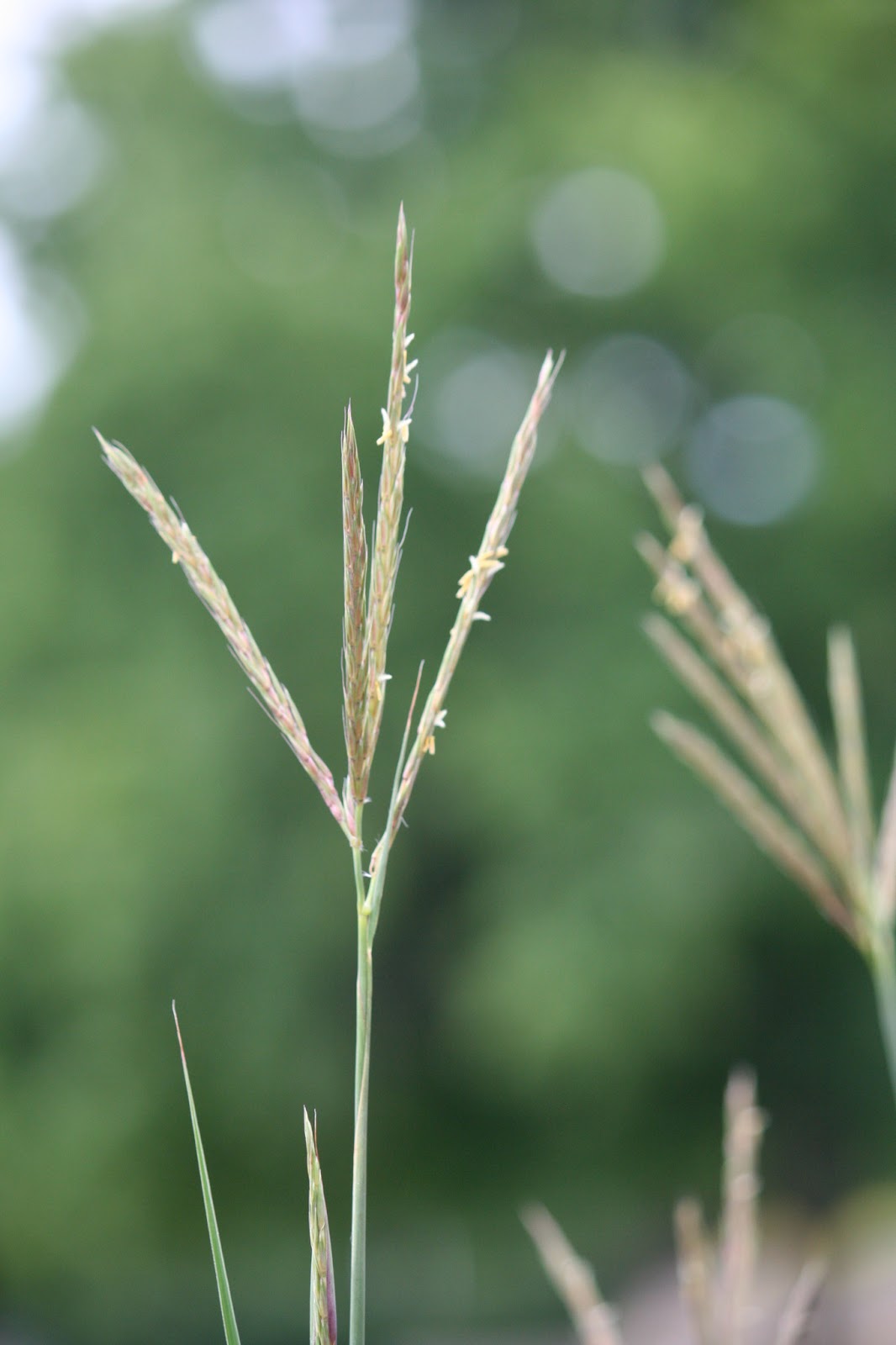
Name for a dynamic duo? Super hero's? Cartoon characters, or Indian tribe names? Nope. Super prairie grasses. Schizachyrium scoparium-Little Bluestem and Andropogon geradii-Big Bluestem or Turkeyfoot.
Schizachyrium scoparium 'the Blues' - Little Bluestem
Last year the Kansas legislature named Little Blue the state grass. During this time the Native Plant Society of Kansas, which was instrumental in achieving this goal, provided funds for educational material to be used for speakers and also for schools. The school materials are being used to inform children of the importance of these prairie grassed in the ecosystem and history of Kansas. 
Andropogon geradii Vitam - Big Bluestem, Turkeyfoot
Turkey foot got its nickname from the native Americans. Most people know it as Big Bluestem. This particular plant is well over 7' tall and was rescued from a vacant industrial lot. It is located on my corner hell strip. Right plant in wrong plant, so after this image was taken I cut it down to three foot along with everything else in the bed. There will be movement this winter. This grass populates a large part of the Kansas Flint Hills and is outstanding forage for grazing cattle as well as seed for wildlife.
 The shape of the seedheads resembles a turkey foot.
As you can see the seed heads even dwarfed the Calamagrostis seedheads.
Or they did in this photo.
 Little Blue and Purple Leaf Coneflower


Saturday, February 23, 2013

In the Winter Doldrums

Much like the sparrow above I'm peeking out of my winter doldrums, but alas I still feel like going back into my hole. I suppose I have been in some form of spring denial, but I know those who are more positive than I have informed me that this too shall pass. And....I know it will.
As you can see snow has been the latest weather event in Kansas, received about 6" over the past 3 days. I have been working hard in my spare time to complete a "Texas" garden room. One of the accents is this bird house designed for finches. It seems the finches could care less but I did notice a chickadee check it out. It will probably become a home for sparrows.
A rusty tulip I received from my late sisters garden.
Bounty of Basil seeds.
A little spiky love in the snow. Yucca gloriosa 'variegata' grouped with Schizachyrium scoparium-Little Bluestem. Farewell from Kansas.

Monday, October 15, 2012

GBBD 10.12

It's that time again ladies and gentlemen, Garden Bloggers Bloom Day. As many of you know Carol at May Dream Gardens sponsors this popular meme every month. Be there are be square.
Fall is here in south central Kansas which is still recovering from a drought. I've had to squeeze my irrigation amount, do to economics. However, we received 1.5 inches of nitrogen fixed rainfall (that means rain with lighting), and this will be a plus before winter sets in. So lets begin with my garden.
Welcome to Kansas-Rudebeckia hirta, Salvia farinacea and Nasella tenuissiama.
Rosa 'Noare'
Rosa 'Noare' and Aster novi-belgii 'Wood's Blue'
 Linaria purpurea and Aster laevis
Schizachyrium scoparium 'The Blues' and Salvia 'Indigo Spires'
Artichoke
 Rudebeckia hirts 'Denver'.
Front walk-kind of hard to walk but it sure does smell good. Mostly globe basil (volunteer) and Salvia.
 Front Hell Strip-Yucca rigida, Panicum amarum 'Dewey Blue', Andropogon gerardii, Agastache
foeniculum, Vicea, Nasella tenuisiuma, and Nepeta.
View from other direction.
Ascelepias incarnata. A few seed head before I make like a tree and leaf.
Datura.